Câble de Changhaï Shenghua (groupe) Co., Ltd.
Ask five suppliers for the same cable and you may receive five different type codes for one product: NYY, N2XY, YJV, VV and U-1000 RVFV can all describe a copper conductor PVC or XLPE insulated power cable of the same size. Buyers lose time and money because of it, ordering the wrong item or rejecting a correct one. This guide provides a practical cross-standard mapping of the type codes used in Europe, China, the Middle East and Latin America, explains which properties the codes do and do not control, and shows how to write a specification that any factory can answer without ambiguity. It ends with six answers on substitution, equivalence and documentation.

A type code is a shorthand for a construction recipe, not a performance guarantee. It tells you the conductor material, the insulation, the sheath, and whether armour, screen or a concentric conductor is present. In Europe, the letters usually come from the German and harmonised tradition; in China, from the GB and JB traditions; in North America, from the UL and ICEA families. Each system encodes slightly different information, and the gaps are where mistakes happen.
Take NYY. The first N indicates a copper conductor according to the German convention, the Y indicates PVC insulation, and the second Y indicates a PVC sheath. N2XY substitutes XLPE for the first PVC layer, so it is an XLPE insulated, PVC sheathed cable. YJV, the common Chinese code, means XLPE insulated, PVC sheathed, copper conductor, which makes YJV and N2XY functionally close relatives even though they come from different systems.
VV, likewise, is PVC insulated and PVC sheathed with a copper conductor, which places it beside the European NYY. Adding a digit for armour changes the meaning quickly: VV22 and YJV22 denote steel tape armour, while NYY with steel tape is often written NYY-J or described in words. The Chinese convention tends to attach the armour and sheath details as suffixes, while the European convention embeds them in the letters.
| Code | Insulation | Sheath | System |
|---|---|---|---|
| NYY | PVC | PVC | German / European |
| N2XY | XLPE | PVC | German / European |
| NAYY | PVC | PVC, aluminium conductor | German / European |
| VV | PVC | PVC | Chinese GB |
| YJV | XLPE | PVC | Chinese GB |
| VV22 / YJV22 | PVC / XLPE | PVC with steel tape armour | Chinese GB |
| NYY-J / NYY-O | PVC | PVC with concentric conductor | German / European |
The first trap is that two codes can describe the same construction but different test regimes. A YJV and an N2XY may both be XLPE insulated and PVC sheathed with the same copper conductor, but one is tested to GB/T 12706 and the other to IEC 60502-1 or a national derivative. In most respects the results are close, yet the paperwork differs, and a project that requires an IEC type test report will not accept a GB-only certificate.
The second trap is the voltage designation. A code that looks identical may be rated 0.6/1 kV in one quotation and 450/750 V in another. Those are different products, and substituting one for the other is a design change, not a translation.
The third trap is conductor class and core construction. The same type code covers 3+1, 3+2 and equal-core constructions, and it says nothing about whether the conductor is class 1, 2 or 5. A buyer who orders NYY 4x25 and expects a flexible conductor will be disappointed, because NYY implies a rigid stranded or solid conductor unless the order says otherwise.
The fourth trap is armour and screen. Adding steel tape, steel wire or a copper screen changes the code, the diameter, the weight and the price, but the base code stays the same, so a careless comparison can look like a price difference on identical goods when it is actually a difference in construction.
The fifth trap is documentation language. A Chinese factory writing YJV/VV and a European factory writing NYY/N2XY may be describing equivalent goods, but their datasheets use different dimension tables, different standard references and different test lists. The purchasing team sees incompatible documents and concludes the products differ.
Do not build the table from memory. Build it from four columns per item: the code, the construction in plain words, the standard and test regime, and the voltage rating. Only when those four match is the substitution safe.
State the construction in words in the purchase order, alongside the code. A line that reads NYY 4x25 mm2, copper class 2 stranded, PVC insulated, PVC sheathed, 0.6/1 kV, IEC 60502-1 leaves nothing to interpret, whether the factory calls it NYY or YJV. That single habit removes most cross-standard disputes.
Ask the supplier to confirm the equivalence in writing when quoting an alternative. A useful answer looks like this: your specification is NYY 4x25; we propose YJV 4x25 to IEC 60502-1, which is identical in construction and test regime, with a GB type test report and a third-party IEC report available. That is a decision a buyer can make. A reply that says only equivalent is not.
Then check the physical details that codes hide: conductor stranding, insulation and sheath thickness, outer diameter and drum length. Two cables meeting the same code can differ in sheath thickness at the lower limit of the tolerance, and that difference matters in a duct or a tray where mechanical protection is the point.
Keep the mapping table as a controlled document, revised when a new market is added. Typical entries include the 0.6/1KV Underground Armored PVC Insulated Cables -20C To 70C For Underground Power Distribution Solutions and the CYKY 5x10mm2 Oxygen-Free Copper PVC Insulated Underground Distribution Cable 0.6/1kV Outdoor alongside the codes most often quoted by your customers. Once the table exists, quotations become faster and errors become rare, because sales and purchasing are working from the same definitions rather than from memory.
For repeat orders, attach the approved sample reference to the table. When a supplier changes compound or stranding, the physical comparison against the retained sample is the fastest way to detect it, long before a test report reveals a performance shift. This is especially important on PVC sheathed constructions, where a compound change is invisible in the datasheet but obvious in the hand.
Two cables can share a type code and differ in voltage class, which makes the rating a required field in any cross-reference, not an optional one. A 450/750 V cable and a 0.6/1 kV cable of the same code and size have different insulation thicknesses and different test voltages, and they are not interchangeable in a distribution circuit even though both may be described as PVC insulated power cable.
When a customer quotes an unfamiliar code, the fastest clarification is to ask for the voltage class, the conductor class and the standard. Those three answers, plus the size and core count, define the product precisely enough for a factory to quote without a drawing. Suppliers who answer with a price before those four facts are established are quoting an assumption.
A cross-reference that lives in correspondence is useful once; a cross-reference that lives in a controlled document is useful indefinitely. The document should carry the date, the author, the source standard for each entry and a note on any known deviation, and it should be reviewed when a new market or a new supplier enters the picture.
The commercial value is easy to see. A buyer who can answer a European enquiry with a Chinese code and a Chinese enquiry with a European code converts faster, because the customer does not have to translate the specification before evaluating the offer. That speed is worth more than a marginal price difference, particularly in markets where several suppliers are technically equivalent.
Most cross-standard errors are made before a technical person sees the enquiry. A sales representative who receives a request for N2XY and quotes YJV without comment is not being dishonest; the representative simply does not know that the customer's consultant may require the European designation on the delivery documents. A short internal table, printed and kept on the desk, removes most of that risk.
The table should fit on one page: the code, the construction in words, the standard and the voltage. Anything more detailed belongs in a technical file, but the one page is what gets used. Refreshing it annually, and after any new market is opened, keeps it accurate without turning it into a project.
It also helps to record which customers use which vocabulary. A European distributor will ask in N codes, an Asian contractor in GB codes, a Middle Eastern trading house in a mixture. Knowing the customer's language shortens every quotation and reduces the chance that a correct product is rejected because the paperwork used unfamiliar letters.
Four rules cover most cross-standard work: codes describe construction and not performance, the standard and voltage must be stated separately, the suffix changes the product, and equivalence should be documented in writing rather than asserted in conversation.
Applying those rules takes a few minutes per enquiry and removes the rounds of clarification that otherwise delay every quotation, particularly where the buyer and the supplier come from different standard traditions.
Functionally they are close: XLPE insulated, PVC sheathed, copper conductor. The difference is the standard and test regime, so confirm the report before substituting.
Both are PVC insulated and PVC sheathed. Verify voltage rating, conductor class and test standard; the codes alone do not guarantee equivalence.
It denotes steel tape armour. The cable becomes heavier and mechanically protected, and the price and diameter change accordingly.
They follow different standard systems, with different dimension tables and test lists. Compare construction and measured values, not the layout.
Not always. The same code appears at 450/750 V and 0.6/1 kV, so the rating must be stated separately in the order.
Provide a four-column comparison: code, construction, standard and voltage, plus test reports for both. Written equivalence is defensible; verbal assurance is not.
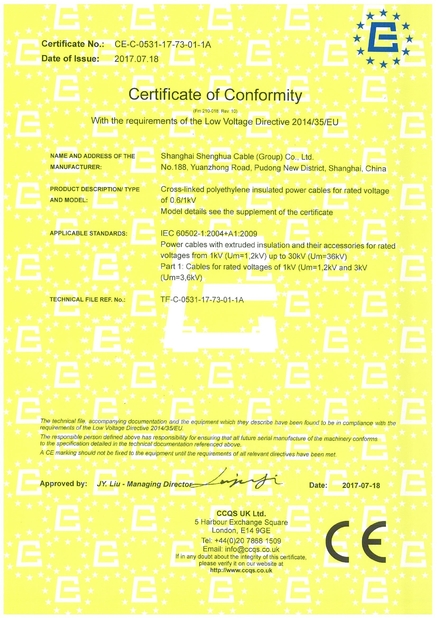
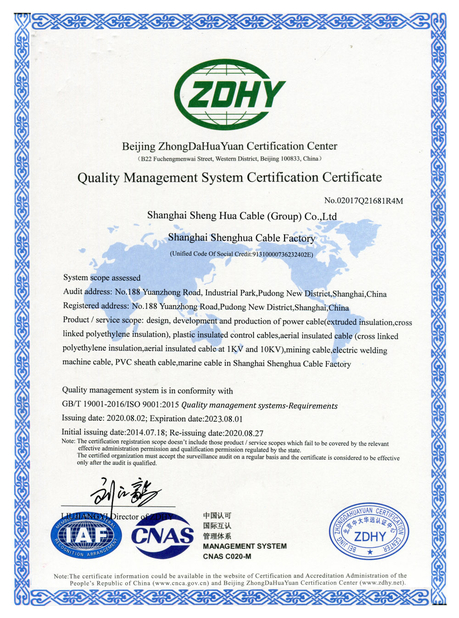
Type codes are a convenience that becomes a liability when treated as universal. Build a controlled cross-reference from construction, standard and voltage rather than from letters alone, state the construction in words on every order, and ask suppliers to confirm equivalence in writing. Shanghai Shenghua Cable Group quotes in European codes such as NYY, N2XY and NAYY as well as Chinese codes such as VV, YJV and KVV, and provides the construction and test data behind each, so that equivalence can be documented rather than assumed. Send your specification through our contact page and we will return a cross-referenced quotation. Typical items include the N2XY 4x95mm2 Oxygen-Free Copper PVC Insulated Multi-core Power Cable 0.6/1kV Power Station, the Armored XLPE Insulated Power Cable Aluminum Conductor Fire Resistant, the VGV 3x4mm2 UV Resistant PVC Insulated Cable Outdoor Overhead 0.6/1kV IEC60502 Copper, the VGV 3x1.5mm2 IP65 PVC Insulated Cable Marine Industrial 450/750V IEC60228 Copper, the Temperature Rating -20C To 70C Multi Core Sheathed Steel Wire Armored PVC Insulated Cables For Underground Ins and the AL/XLPE/PVC Unarmoured Electrical Cable 12/20KV 3 Core 300mm2 XLPE Insulated Power Cable Electric Cable.
Equivalence is a technical statement, not a sales one. Supporting it with construction, standard and voltage data makes it credible, and credibility is what wins repeat orders in export markets.
A controlled cross-reference is a commercial asset: it shortens quotations and prevents costly substitutions across every export market.
Rules that are written down and reused beat expertise that is remembered differently by each salesperson. Keep the table current and apply it to every enquiry, so that a coded request always produces a construction that both sides understand.